Iron-Rich Meal Plan: Family-Friendly Foods That Boost Absorption
Building an iron-rich meal plan doesn’t have to mean expensive groceries, complicated recipes, or nightly dinner-table negotiations. Whether you’re managing food noise changes, low energy, or just trying to fuel your family better, iron is a critical (and often overlooked) mineral.
Below is a real-life guide that breaks down:
- Heme vs. non-heme iron
- Why your iron lab number isn’t the most important one
- Picky-eater strategies that actually work
- A budget-friendly, family-approved weekly meal plan
Why Iron Matters (Quick but Important)
Iron helps red blood cells carry oxygen throughout your body. When iron is low, oxygen delivery suffers—and that can look like:
- Fatigue that doesn’t match your sleep
- Brain fog
- Headaches
- Low stamina or motivation
You can be eating enough food and still struggle if iron isn’t being absorbed or stored properly.
Heme vs. Non-Heme Iron: What’s the Difference?
Not all iron works the same way in your body. Understanding this is how you stop spinning your wheels.
Heme Iron (The High-Efficiency Option)
Found in:
- Red meat
- Poultry
- Fish
Why it matters:
Your body absorbs 25–30% of heme iron easily.
Budget tip:
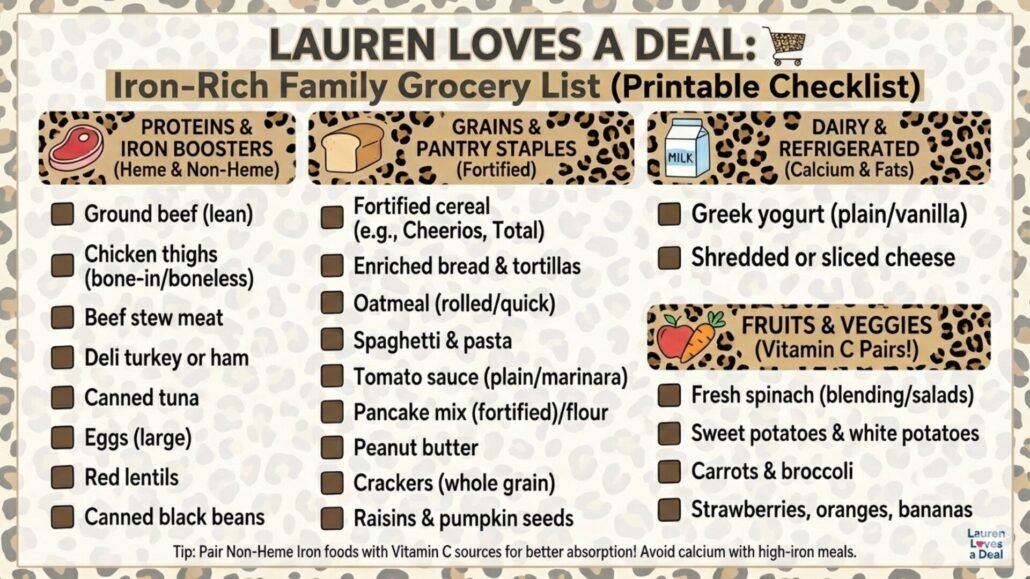
Ground beef and chicken thighs are two of the most affordable, reliable heme-iron sources.
Non-Heme Iron (The Plant-Powered Option)
Found in:
- Beans and lentils
- Spinach
- Fortified cereals and breads
The catch:
Absorption is lower—around 2–10% on its own.
The hack:
Pair non-heme iron with vitamin C (oranges, strawberries, bell peppers). This can triple absorption.
Why Your Iron Lab Result Isn’t the Star of the Show
This part trips up a lot of people—and it matters.
Serum Iron Is a Snapshot, Not the Story
Your “iron” number shows how much iron is circulating in your blood at that exact moment. It can change based on:
- What you ate recently
- Supplements
- Inflammation or illness
- Even the time of day
You can have normal or high serum iron and still be iron deficient overall.
Think of serum iron like checking how much cash is in your wallet—it doesn’t tell you what’s in savings or whether you’re running out.
The Iron Labs That Matter More
Ferritin (Iron Storage)
Ferritin shows how much iron your body has stored long-term.
- Low ferritin = empty reserves
- Symptoms often appear before anemia does
- This is why people feel exhausted while being told labs are “normal”
- Ferritin reflects how much iron your body has stored, while transferrin and saturation show how efficiently iron is being transported and used — not just whether it’s present in the bloodstream.
Read more from the Cleveland Clinic here
Hemoglobin & Hematocrit (Oxygen Delivery)
These show whether red blood cells can carry oxygen efficiently.
- They drop later in deficiency
- By the time they’re flagged, iron has often been low for a while
TIBC, Transferrin & Saturation (Iron Transport)
These reflect how hard your body is working to move iron around.
- High values can mean your body is scrambling for iron
- Iron may be present but poorly utilized
Big takeaway:
Iron deficiency is about absorption, storage, and delivery — not just intake.
That’s why food strategy matters just as much as lab numbers.
Picky-Eater Strategies That Don’t Feel Like a Battle
These swaps keep meals familiar while quietly boosting iron.
✔️ The Double-Blend
Blend lentils or spinach into red pasta sauce. Tomato color hides everything.
✔️ Familiar Shapes
Meatballs, nuggets, patties, quesadillas—handheld foods are usually a yes.
✔️ The Breakfast Upgrade
Swap standard cereal for iron-fortified cereal. Same habit, better payoff.
The Affordable Iron-Rich Weekly Meal Plan
This plan focuses on batch cooking, ingredient overlap, and foods kids actually eat.
| Day | Breakfast | Lunch | Dinner |
|---|---|---|---|
| Mon | Fortified cereal + strawberries | Turkey or ham & cheese wrap | Beef & bean tacos (50/50 beef + mashed black beans) |
| Tue | Scrambled eggs on enriched toast | Leftover taco bowl | Chicken thighs & sweet potatoes |
| Wed | Oatmeal with raisins & seeds | PB & banana sandwich | Spaghetti with hidden spinach meatballs |
| Thu | Fortified cereal + orange slices | Leftover spaghetti | Spinach & cheese omelets + hashbrowns |
| Fri | Greek yogurt + pumpkin seeds | Tuna salad & crackers | Chicken & white-bean nuggets + broccoli |
| Sat | Hard-boiled eggs & fruit | Turkey & spinach quesadillas | Slow cooker beef stew |
| Sun | Pancakes (fortified flour) | Leftover stew | Red lentil dahl or lentil-boosted pasta |
Iron Content Cheat Sheet
Average iron per serving
| Food | Iron (mg) | Type |
|---|---|---|
| Fortified cereal (1 cup) | 18.0 | Non-heme |
| Chicken liver (3 oz) | 10.0 | Heme |
| Lentils (½ cup cooked) | 3.3 | Non-heme |
| Spinach (½ cup cooked) | 3.2 | Non-heme |
| Ground beef (3 oz) | 2.2 | Heme |
| Chicken thigh (3 oz) | 1.1 | Heme |
| Egg (1 large) | 0.9 | Mixed |
Pro Tip: Maximize Iron Absorption
Avoid calcium with iron-heavy meals.
Calcium competes with iron for absorption.
Serve iron-rich meals with water or a small glass of orange juice, and save milk or cheese for snack time instead.
Bottom Line
You don’t need:
- Expensive cuts of meat
- Separate “kid food” and “adult food”
- Fancy supplements out of the gate
You do need:
- Smart pairings
- Consistency
- A plan that fits real life
Iron-rich eating can be affordable, realistic, and family-friendly—without turning dinner into a standoff. If iron has entered the chat for you too, this is one to bookmark.
Love what you just read? Be sure to sign up for my newsletter to never miss content!
Medical Disclaimer:
This content is for educational and informational purposes only and is not intended as medical advice. I am not a medical professional. Always consult your healthcare provider before making changes to your diet, supplements, or treatment plan—especially if you have underlying health conditions or are managing iron deficiency or anemia.