

How GLP-1 Medications Work: Food Noise & Obesity
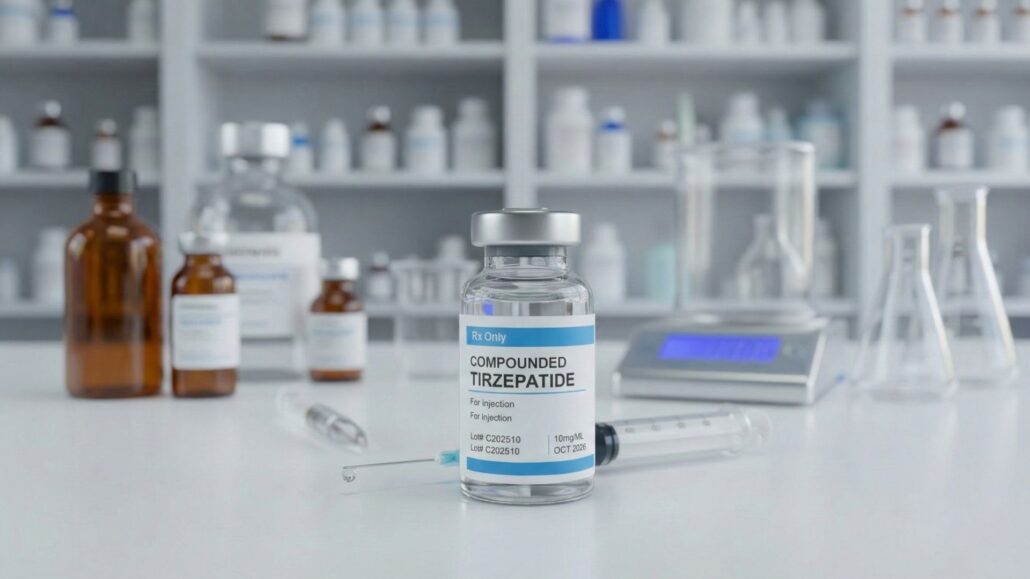
If you’ve landed here, chances are you’ve heard something about GLP-1 medications.
Maybe it was:
- “They’re cheating.”
- “Once you stop, you’ll gain it all back.”
- “It’s just appetite suppression.”
- “If you had more discipline, you wouldn’t need it.”
Let’s get this out of the way first:
Obesity is a disease.
Not a character flaw. Not a moral failing. Not a lack of willpower.
The CDC classifies obesity as a chronic disease associated with significant health risk, not a lifestyle choice.
👉 Adult Obesity Facts – CDC
And multiple medical organizations — including the Endocrine Society — treat it as a chronic condition requiring long-term management, not lectures.
👉 Obesity – Endocrine Society
And yes — while obesity is not your fault, it is your responsibility to treat it.
Just like asthma. Just like diabetes. Just like high blood pressure.
GLP-1 medications didn’t create a shortcut.
They finally gave people with obesity a tool that works with their biology instead of against it.
This post is a plain-English, no-BS introduction to how GLP-1s work, what “food noise” actually is, and why so many people feel like their brain finally got quieter — not just the scale.
First: What Is a GLP-1?
GLP-1 stands for glucagon-like peptide-1 — a hormone your body already makes.
It plays a role in:
- Regulating blood sugar
- Signaling fullness
- Slowing stomach emptying
- Communicating with appetite centers in the brain
In people without metabolic dysfunction, this system works pretty smoothly.
In people with obesity?
Those signals are often blunted, delayed, or overridden.
GLP-1 medications simply enhance a hormone your body already uses — they don’t override biology, they restore it.
Why “Eat Less, Move More” Was Never the Full Story
This is where diet culture did real damage.
For decades, people were told that weight loss was simple:
Eat less. Move more. Try harder.
When that didn’t work long-term — and for most people, it didn’t — the conclusion wasn’t:
“This framework is incomplete.”
It was:
“I must be failing.”
Diet culture trained people to:
- Ignore hunger cues
- Moralize food (good vs bad)
- Tie self-worth to the scale
- View regain as personal weakness
- Live in cycles of restriction and guilt
The problem is, biology always wins.
Research shows that after weight loss, the body often responds by:
- Increasing hunger signals
- Lowering energy expenditure
- Becoming more metabolically efficient
This phenomenon is often referred to as metabolic adaptation, and it’s well documented in the medical literature.
👉 Physiology of Energy Expenditure in the Weight-Reduced State – PubMed Central
Hormones like leptin and ghrelin also shift during weight loss in ways that promote hunger and weight regain — even when someone is “doing everything right.”
👉 PTK7 expression in triple-negative breast cancer – PubMed Central
So when someone says “just eat less,” they’re ignoring:
- Hormonal signaling
- Metabolic adaptation
- Genetics
- Neurochemistry
- Stress physiology
- Weight-loss history
GLP-1 medications don’t replace effort — they fill in the biological context diet culture left out.
How GLP-1 Medications Work (In Real Life Terms)
GLP-1 medications work on multiple systems at once:
1. They Improve Satiety Signals
You feel full sooner — not stuffed, not sick — just done.
2. They Slow Gastric Emptying
Food leaves your stomach more slowly, which:
- Keeps blood sugar steadier
- Reduces rapid hunger rebounds
- Helps with portion regulation
This mechanism is clearly outlined in FDA prescribing information for GLP-1 medications.
3. They Act on the Brain
This is the part people don’t talk about enough.
GLP-1 receptors are active in parts of the brain involved in appetite regulation and reward signaling.
Which brings us to food noise.
What Is “Food Noise”?
Clinically speaking:
Food noise refers to persistent, intrusive thoughts about food — eating, not eating, what you ate, what you shouldn’t eat, what’s next, what you regret.
In real life?
It’s exhausting.
And it doesn’t always look like overeating.
For many people, food noise isn’t:
- Bingeing
- Large portions
- Constant snacking
It’s:
- Guilt before you even eat
- Negotiating with yourself all day
- Feeling like food takes up way too much mental space
- Assigning morality to every bite
That was my experience.
It wasn’t that I wanted more food.
It was that food lived rent-free in my head.
The Motel Room Analogy (If You Know, You Know)
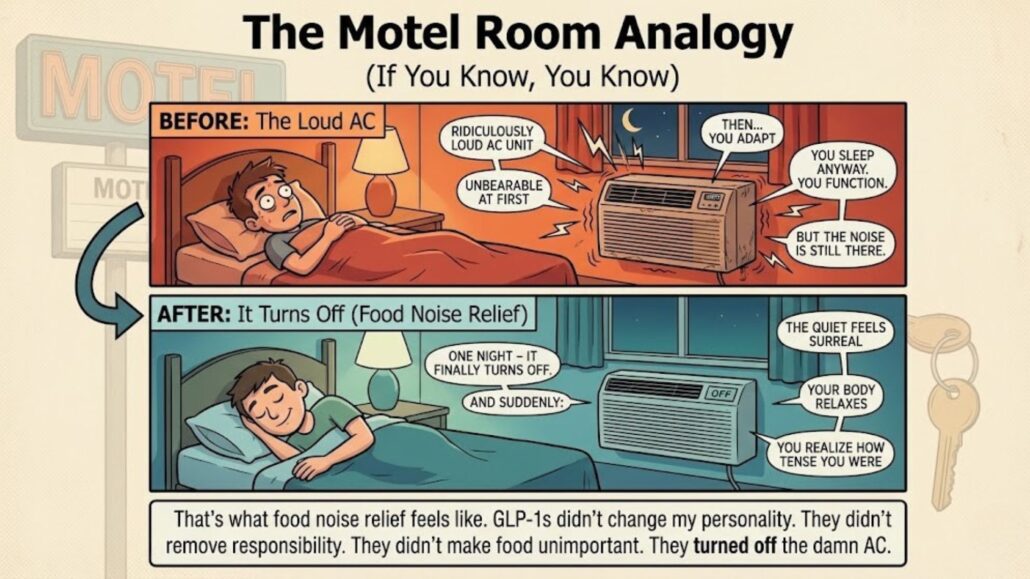
Imagine staying in a motel room with a ridiculously loud AC unit.
At first, it’s unbearable.
Then… you adapt.
You sleep anyway.
You function.
But the noise is still there.
You don’t realize how loud it was until one night —
it finally turns off.
And suddenly:
- The quiet feels surreal
- Your body relaxes
- You realize how tense you were the whole time
That’s what food noise relief feels like.
GLP-1s didn’t change my personality.
They didn’t remove responsibility.
They didn’t make food unimportant.
They turned off the damn AC.
GLP-1 Medications Are Not “Just Appetite Suppressants”
Here is a huge misconception fueled by diet culture.
Appetite suppressants force hunger down.
GLP-1s normalize appetite signaling.
That’s a massive difference.
This is why people say:
- “I forgot to eat”
- “I can stop when I’m satisfied”
- “Food doesn’t control my mood anymore”
That’s not willpower.
That’s biology finally cooperating.
Sema vs Tirz: What’s the Difference?
Semaglutide (Sema)
- Mimics GLP-1 only
- Strong appetite and satiety effects
- Long safety track record
- Effective for many people
Tirzepatide (Tirz)
- Mimics GLP-1 + GIP
- Dual-hormone action
- Improves insulin sensitivity
- Often associated with greater metabolic effects
Tirzepatide’s dual mechanism is outlined in FDA labeling.
Neither medication is universally “better.”
Different bodies respond differently.
This is about fit, not hierarchy.
Obesity Is a Disease — Not a Discipline Problem
This is the part that still makes people uncomfortable.
If obesity is a disease, then:
- Shame stops being motivational
- Thinness stops being a moral achievement
- “Try harder” stops being a treatment plan
Science doesn’t care about discomfort.
Obesity involves hormonal, metabolic, genetic, and neurochemical factors — and treating it requires more than calorie math.
GLP-1s don’t erase responsibility.
They make responsibility possible without constant self-punishment.
Not Your Fault — Still Your Responsibility
This matters.
GLP-1s are not a magic fix.
They don’t replace:
- Protein intake
- Strength training
- Lab monitoring
- Long-term habit work
What they do is remove friction.
- You still show up.
- You still make choices.
- You still build a life that supports your health.
But now?
You’re not doing it inside a system designed to blame you.
The Takeaway
Diet culture told us:
“If it’s hard, you’re weak.”
Science says:
“If it’s hard, something is off biologically.”
Ultimately, GLP-1 medications don’t change who you are.
They change the environment your body is operating in.
And for many people, that changes everything.
Speaking of everything changing, here’s the proof in the pudding.

Love this kind of content? Be sure to check out my whole story here